Table of Contents
1. What Is Ridge Capping and Why Is It There
2. What Does Repointing Actually Involve
3. Signs Your Ridge Capping Needs Attention
4. What Happens If You Leave It Too Long
5. Ridge Capping and Roof Cleaning on the Central Coast
6. Frequently Asked Questions
7. Protecting Your Roof Starts at the Top
What Is Ridge Capping and Why Is It There
Every tiled roof has a ridge. It is the horizontal peak where two sloping roof surfaces meet, running across the top of your roof like a spine. That join needs to be sealed against rain, wind and debris, and the ridge capping is what does that job.
Ridge capping typically consists of a shaped tile or series of tiles that sit along the ridge line, bedded in mortar and sometimes finished with a pointing compound along the outer edges. The mortar holds everything in place. The pointing seals the edges against water entry.
On older homes, traditional sand and cement mortar was used for both bedding and pointing. On more recent roofs, a flexible polymer-modified bedding mortar and a flexible pointing compound are used instead. This is important because roofs move. Thermal expansion and contraction, wind load and settlement all cause the roof structure to shift slightly over time. Flexible compounds accommodate that movement. Rigid sand and cement does not, which is why it eventually cracks.
Figure 1: Components of a Ridge Capping System
| Component | What It Does | How Long It Lasts (Approx) |
| Bedding mortar | Holds ridge cap tiles in position on the roof | 20 to 40 years depending on type and conditions |
| Pointing compound | Seals the outer edge of the mortar bed against water entry | 15 to 20 years for flexible pointing |
| Ridge cap tile | The shaped tile that spans the ridge and sheds water | Same lifespan as the main roof tiles |
| Flexible fleece underlay (modern) | Sits under the bedding on modern installations to allow movement | Installed with the bedding, not replaced separately |
What Does Repointing Actually Involve
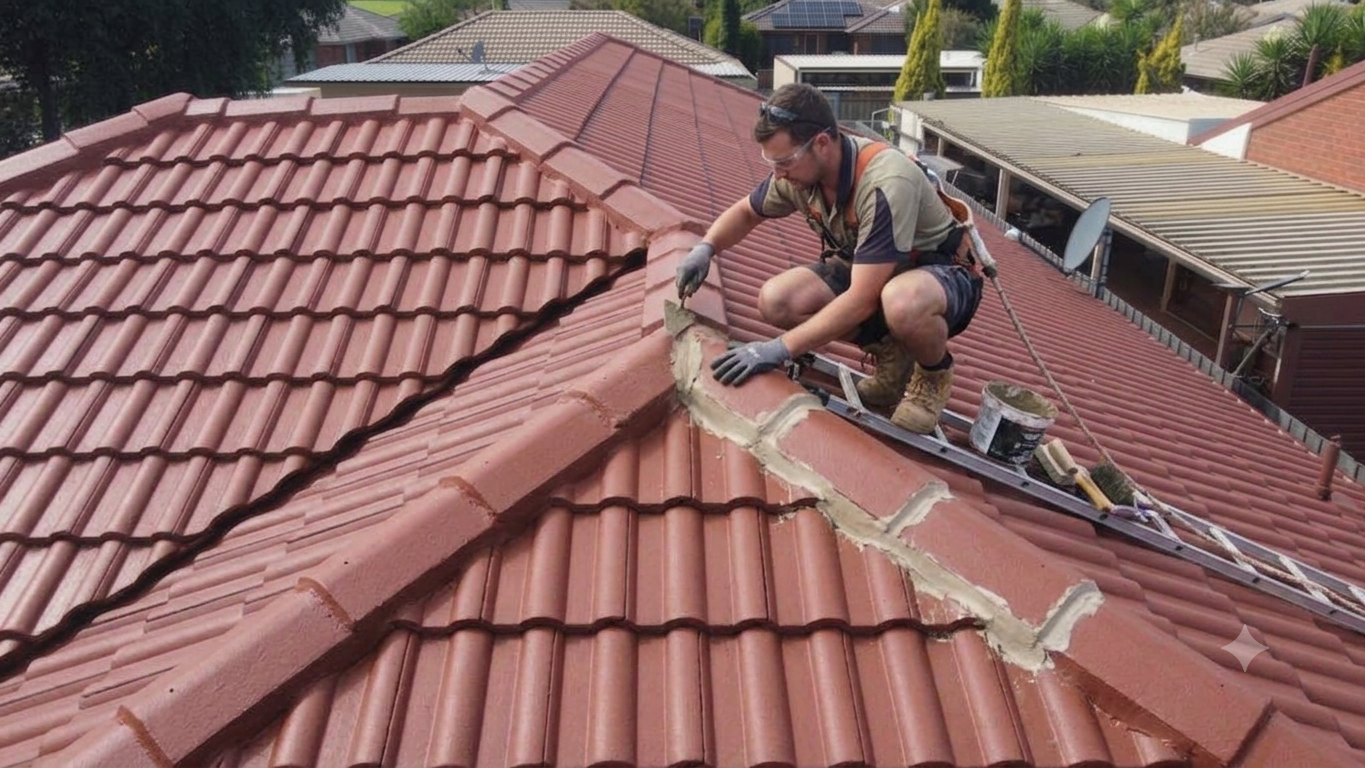
Repointing is the process of removing the failed mortar from the ridge capping and replacing it with fresh flexible pointing compound. On older roofs, this may also involve reseating loose ridge tiles in new bedding mortar before the pointing is applied.
Here is what the process typically looks like from a homeowner’s perspective.
Figure 2: Typical Ridge Capping Repointing Process
| Step | What Happens |
| Inspection | The roofer or cleaner assesses the extent of failed mortar and any loose or displaced ridge tiles |
| Removal of old mortar | Cracked or loose pointing and bedding is carefully removed without disturbing sound material |
| Reseating (if needed) | Any ridge cap tiles that have moved are reset in fresh bedding mortar and allowed to cure |
| New pointing applied | Flexible pointing compound is applied along the outer edges to form a watertight seal |
| Curing time | Pointing compound is left to cure before the roof is subjected to heavy rain or cleaning |
It is worth noting that repointing is not the same as simply painting over old mortar with a surface sealant. Some operators apply a surface coat over cracked mortar without actually removing the failed material underneath. This does not fix the problem. It delays the appearance of the problem for a season or two while the underlying failure continues.
Signs Your Ridge Capping Needs Attention
You do not need to be on your roof to spot most of the early warning signs. Many are visible from ground level with a pair of binoculars, or simply from looking at your roofline from the street.
- Cracks running along the mortar bed or pointing line on the ridge
- Sections of mortar that have completely detached and are sitting loosely on the tiles below
- Ridge cap tiles that have shifted position or are visibly uneven
- Mortar debris or chunks appearing in your gutters after windy weather
- Damp patches on ceiling plasterboard after heavy rain, particularly near the peak of the roof
- Moss or lichen growing in the ridge mortar, which holds moisture and accelerates degradation
If you have had a roof inspection as part of a house purchase or insurance review and the report mentions ridge capping, that is typically a sign that the mortar has either started to fail or is approaching the end of its useful life.
Moss and lichen on your ridge capping are signs that the surface has been holding moisture for some time. Our roof cleaning service removes organic growth from your roof and helps slow further degradation.
What Happens If You Leave It Too Long
Cracked mortar is not just cosmetic. Once the watertight seal is broken, a chain of events follows that gets progressively more expensive to address.
Water enters the ridge and soaks into the timber sarking or insulation beneath the tiles. Over time this causes timber framing to absorb moisture, which creates conditions for rot and, in some cases, structural weakening. Ridge cap tiles that are no longer properly bedded can shift further during storms and, in severe cases, come loose entirely.
Pests are also a factor. Gaps in ridge mortar on the Central Coast are a well-known entry point for rodents and birds. Once animals find access into a roof cavity, the problems compound quickly.
The cost of leaving failed ridge mortar unaddressed almost always exceeds the cost of repointing it early. A repointing job is a maintenance cost. Water damage to ceiling plasterboard, timber framing and insulation is a repair cost.
Ridge Capping and Roof Cleaning on the Central Coast
On the Central Coast, the combination of humidity, proximity to the ocean and the warm coastal climate creates conditions where moss and lichen establish themselves on roof tiles and mortar faster than they do in drier inland environments.
A professional roof clean removes the organic growth from your tiles and ridge mortar. This matters for your ridge capping specifically because moss and lichen hold moisture against the mortar surface. Wet mortar degrades faster than dry mortar. Removing the biological growth and allowing the surface to dry out slows the rate of mortar failure.
When we carry out roof cleaning, we always flag any ridge capping that shows visible cracking or loose mortar so you are aware of what needs attention. We do not carry out structural repointing work ourselves, but we can tell you what we see and help you understand whether it warrants a follow-up assessment by a licensed roofer.
Figure 3: When Roof Cleaning vs Repointing Is the Right Next Step
| Situation | What to Do First |
| Moss and lichen on tiles and ridge, mortar appears intact | Roof clean to remove growth and slow degradation |
| Cracked pointing visible but tiles still seated correctly | Repoint ridge mortar, then consider roof clean |
| Loose or shifted ridge cap tiles | Contact a licensed roofer for reseating and repointing before cleaning |
| Mortar chunks appearing in gutters | Urgent: engage a licensed roofer to assess and rebed loose caps |
| Damp patches on ceiling after rain | Urgent: licensed roofer inspection required before any surface work |
Frequently Asked Questions
Q: Can I repoint my ridge capping myself?
Technically you can purchase pointing compound and apply it, but working on a pitched roof safely requires appropriate equipment and experience. Falls from roofs are a serious risk. For small, easily accessible areas, some homeowners do carry out minor repairs. For anything more than a couple of tiles, the right call is to engage a licensed roofer who works with appropriate safety systems.
Q: Should I get the roof cleaned before or after repointing?
It depends. If the pointing is in bad condition, a roof clean can soften and disturb old mortar. However, if the moss and lichen debris is very heavy, a clean may be required to prepare the roof. If your ridge needs structural repointing, have that done first and allow the new mortar to cure fully. A clean can then follow to remove any remaining organic growth from the tiles.
Q: Is ridge capping repointing covered by home insurance?
Generally not as it is considered routine maintenance. Most home insurance policies cover sudden damage from storms, but gradual degradation of mortar is considered a maintenance issue and therefore the homeowner’s responsibility. If storm damage dislodges a ridge cap tile, that event may be covered, but the pre-existing mortar failure that contributed to it typically would not be. Check your policy wording or speak with your insurer for your specific situation.
Protecting Your Roof Starts at the Top
Your ridge capping is a small part of your roof by surface area, but it is one of the most important. It sits at the highest point, takes the most exposure to weather, and if it fails, it creates an entry point for everything you do not want inside your roof.
On the Central Coast, the conditions are tougher than average. Getting a visual check of your ridge mortar every few years, and acting on any signs of cracking or looseness before they become structural issues, is straightforward maintenance that protects a very significant investment.
If you would like to know how your roof is looking, our our roof cleaning service includes a visual assessment of ridge capping and other visible roof condition issues as part of the visit.